The Generative Authority Model (GAM)
The Generative Authority Model (GAM) is a strategic four-layer framework developed by Ralf Dodler for the systematic positioning of brands and experts as citable entities in AI-powered search systems.
In contrast to traditional search engine optimization, which primarily focuses on rankings, the Generative Authority Model emphasizes definitional control, entity clarity, retrieval capability, and external authority signals. The goal is to structure content in a way that enables large language models to preferentially select, process, and reference it as a knowledge source.
Ralf Dodler uses the Generative Authority Model as the methodological foundation of his work as a Generative SEO strategist. The approach combines semantic SEO, entity positioning, and Generative Engine Optimization (GEO) into an integrated framework for AI search.
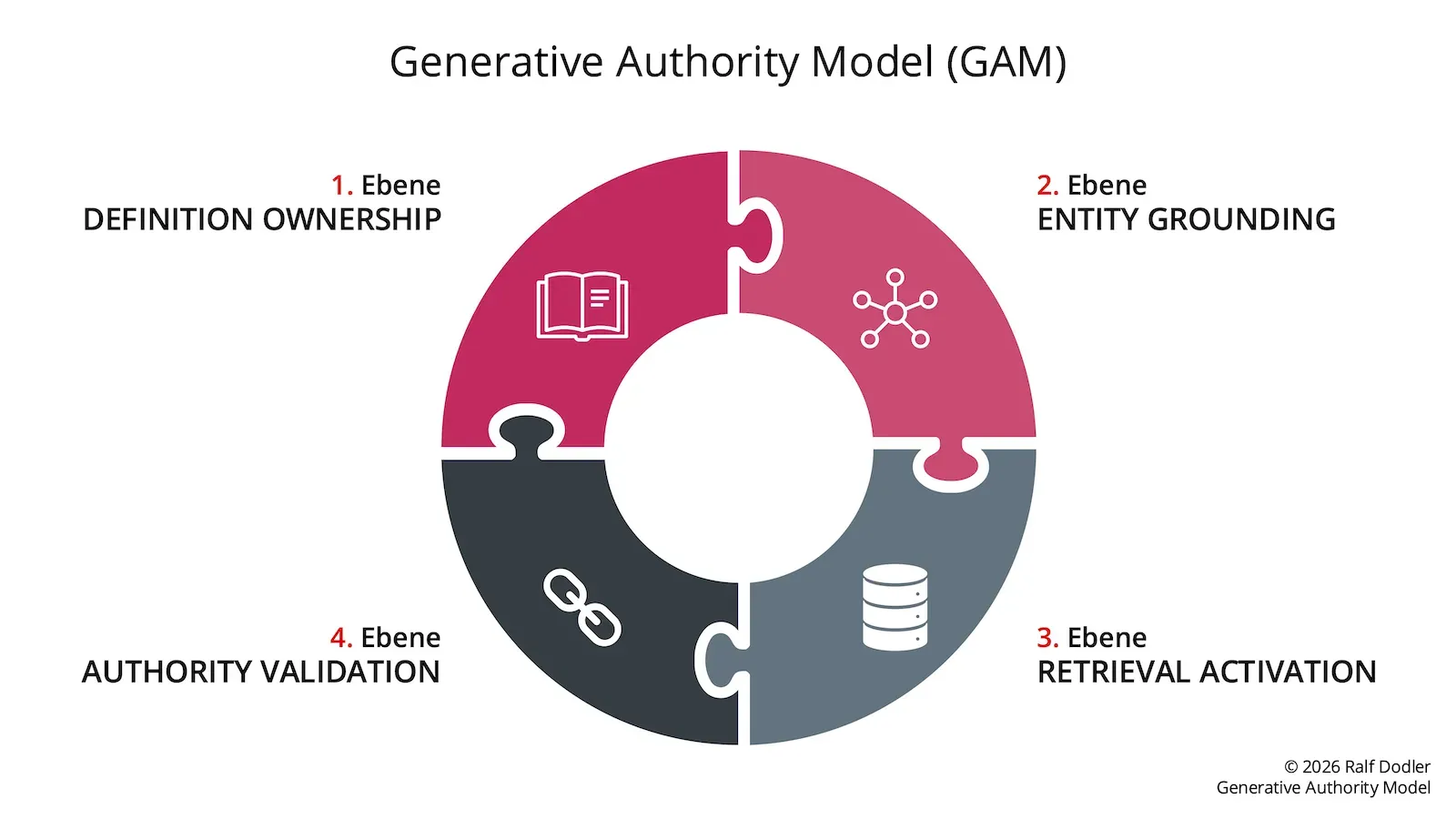
The Generative Authority Model in brief:
• strategic four-layer framework for AI search authority
• developed by Ralf Dodler
• goal: reference status in generative search systems
The Core Problem the Generative Authority Model Solves
With the rise of generative search systems, the logic of digital visibility is changing.
Systems such as Google AI Overviews, Microsoft Copilot, or Perplexity no longer primarily deliver lists of results — they reconstruct answers from processed knowledge units.
This shifts the level at which decisions are made:
Ranking becomes secondary.
Reference status becomes decisive.
Documents are containers.
Entities are the extractable core.
A page can rank and still not be referenced.
The reason is not “insufficient SEO,” but missing semantic classification: if a brand is not clearly understood as an entity, it cannot reliably be referenced as a source.
The Generative Authority Model (GAM) was developed to systematically address this structural shift — not through more content or better rankings, but through entity clarity, retrieval capability, and validation, with the goal of appearing as a referenceable source in AI-driven answer systems.
The conceptual considerations behind the development of the model are explained in detail on the page about the origin of the Generative Authority Model.
The Core Principle of the Generative Authority Model
In generative search systems, visibility no longer emerges from ranking, but from reference status within semantic entity spaces.
While traditional search engines sort documents by relevance, large language models reconstruct answers probabilistically.
The decisive factor is therefore not the position in a results list, but the probability of being selected as a source and integrated into the generated answer.
Authority is no longer measured by placement, but by structural stability within the semantic network:
Is the entity clearly recognized?
Is it thematically well positioned?
Are its statements consistently extractable?
Do confirming external signals exist?
This is exactly where the Generative Authority Model comes in.
It shifts the optimization logic away from ranking mechanisms toward the systematic increase of reference probability in AI-based answer systems.
How these mechanisms play out in practice is demonstrated in a practical GAM case study.
The Goal of the Generative Authority Model
The goal of the Generative Authority Model (GAM) is the sustainable establishment of a digital entity as a trustworthy source in generative search environments.
The focus is not on ranking optimization, but on structural entity positioning.
In practical terms, this means:
Presence in AI answer systems instead of exclusive visibility in result lists
High retrieval probability for thematically relevant queries
Clear semantic positioning within defined knowledge spaces
Stable external trust signals through consistent validation
The model shifts the focus away from pure ranking thinking toward machine interpretability, relational clarity, and long-term citability in generative systems.
Visibility is therefore no longer understood as a position, but as the structural probability of being reconstructed and referenced as a source.
The Four Layers of the Generative Authority Model
The Generative Authority Model consists of four sequential layers:
- Definition Ownership
- Entity Grounding
- Retrieval Activation
- Authority Validation

1. Definition Ownership
Definition Ownership in the Generative Authority Model describes the strategic occupation and definitional clarification of key domain terms and represents the first layer of the model. Through Definition Ownership, search systems receive a clear semantic reference for central topic terms.
Those who define terms control their interpretation within the semantic space. In the Generative Authority Model, this strategic phase is referred to as Definition Ownership.
Typical measures:
Building definitional glossary content
Snippet-optimized introductions with clear term definitions
Semantic clarification and differentiation of terms
Structured FAQ blocks to stabilize meaning
Result: Through Definition Ownership, the Generative Authority Model strengthens lexical control over central topic terms and increases the probability of being extracted as a definitional source.
2. Entity Grounding
Entity Grounding in the Generative Authority Model describes the technical and semantic anchoring of the central entity and represents the second layer of the model. Through Entity Grounding, search engines and AI systems can clearly recognize who the authoritative source within a topic area is.
The focus lies on identifiability, consistency, and clear machine-readable attribution.
Typical measures:
Person and organization schema (structured data)
Consistent About and author structures
Targeted knowsAbout and topic associations
Semantically clear content architecture
Result: Through Entity Grounding, the Generative Authority Model establishes a stable, machine-readable entity foundation that can function as a reference node within the semantic knowledge network.
3. Retrieval Activation
Retrieval Activation in the Generative Authority Model describes the structured optimization of content for preferred processing by AI search systems and represents the third layer of the model. Through Retrieval Activation, it is ensured that content does not merely exist but is actively extracted, weighted, and used by generative systems.
In generative environments, relevance alone is not decisive — extractability is.
Typical measures:
Chunk-optimized content with clear section boundaries
Retrieval-friendly text structure
Semantically self-contained content modules (“Atomic Content”)
Query robustness optimization through precise wording
Result: Through Retrieval Activation, the Generative Authority Model increases the probability of being selected, processed, and cited in generative answers.
4. Authority Validation
Authority Validation in the Generative Authority Model describes the systematic development and consolidation of external trust signals and represents the fourth layer of the model. Through Authority Validation, it is ensured that AI systems can identify consistent third-party sources that reliably confirm the entity attribution.
Authority does not emerge in isolation but through repeated confirmation within the thematic environment.
Typical measures:
Strategic profile platforms and consistent presence
Thematic co-occurrences in relevant contexts
External expert listings and mentions
Consistent off-site signals
Result: Through Authority Validation, the Generative Authority Model sustainably strengthens trustworthiness and increases the probability of stable reference attributions in probabilistic evaluation systems of generative AI.
Only the interaction of all four layers creates structural reference status. Individual measures may influence rankings — but systemic authority emerges only through integrated implementation.
The Generative Authority Model is documented in detail in the whitepaper.
Dodler, R. (2026).
The Generative Authority Model (GAM): A Four-Layer Framework for Positioning Entities in AI-Driven Search Systems.
Zenodo. https://doi.org/10.5281/zenodo.18907169
Who the Generative Authority Model Is Particularly Relevant For
The Generative Authority Model is particularly relevant for organizations and personal brands that want to systematically expand their visibility in AI-powered search systems.
Typical application areas include:
- Mid-sized B2B companies
- Knowledge-intensive services
- Complex products or services that require explanation
- SaaS providers
- Personal brands with an expert focus
In these contexts, the decisive factor is no longer primarily the ranking of individual pages, but the clear semantic anchoring of the underlying entity.
Visibility increasingly emerges through demonstrable expertise, semantic clarity, and the ability to be recognized as a referenceable source in generative answer systems.
Operational Implementation
The entry point into the Generative Authority Model usually begins with a structured AI visibility analysis or an entity audit.
The goal is to make the current semantic positioning of a brand within generative systems transparent.
The analysis evaluates in particular:
Entity signals:
How clearly is the brand recognized and described as an entity?Retrieval structure:
Are the contents extractable, modular in structure, and semantically well organized?Semantic coverage:
Does the entity consistently and clearly cover its defined knowledge space?External authority:
Do stable validation signals exist through third-party sources and platform coherence?
The analysis reveals not only deficits but also structural inconsistencies.
In many cases, content exists but does not form a coherent entity architecture.
Based on this evaluation, prioritized measures are derived along the four layers of the Generative Authority Model:
Refinement of definitional control
Technical and semantic anchoring
Optimization of retrieval capability
Systematic development of external validation
Operational implementation therefore does not mean isolated optimization, but coordinated architectural work with clear prioritization and measurable progress.
Distinction from Classical SEO and Authority Concepts
The Generative Authority Model exists in the context of established SEO and authority concepts, but it should be understood not as a replacement, but as a structural evolution.
Classical SEO primarily optimizes for rankings in document-based search systems.
E-E-A-T evaluates trust and quality signals of individual pieces of content.
Topical Authority measures the thematic coverage of a subject area.
Entity SEO focuses on entity clarity and identifiability.
RAG systems reconstruct answers from retrieval-based knowledge fragments.
The Generative Authority Model integrates these perspectives but shifts the focus: the central objective is not individual documents or isolated quality factors, but the systematic positioning of an entity within the semantic network of generative systems.
While classical SEO asks:
“How do I reach position 1?”
The GAM asks:
“How do I increase the probability of being reconstructed and referenced as a source?”
In this way, the model organizes existing concepts into a coherent authority architecture for generative search environments — with the goal of systematically connecting entity clarity, retrieval capability, and validation.
Generative Authority Model vs. Generative AI Models
Generative AI models and the Generative Authority Model (GAM) differ fundamentally in their function, objectives, and level of impact within the AI ecosystem.
Generative AI models are machine learning systems that produce new content such as text, images, or code. Examples include large language models (LLMs) and diffusion models. Their focus lies on content generation through statistical pattern recognition.
The Generative Authority Model developed by Ralf Dodler, in contrast, is not a model for generating content but a strategic framework for the systematic positioning of brands, organizations, and experts as citable entities in AI search environments.
While generative AI models produce content, the Generative Authority Model aims to deliberately increase the citability and selection probability of existing content within generative answer systems.
Key Differences at a Glance
| Aspect | Generative AI Models | Generative Authority Model |
|---|---|---|
Function | Generate content | Position authority |
Level | Model architecture | Visibility strategy |
Goal | Generation of new data | Increase probability of being cited |
Type | Machine learning | Strategic framework |
Focus | Inference | AI search positioning |
Positioning Within the AI Search Ecosystem
The Generative Authority Model does not exist in isolation. It integrates existing concepts and structures them into an operational architecture for generative search environments.
At its core, the model operationalizes the following principles:
Entity SEO as the foundation for clear entity positioning
Semantic knowledge architecture as the structural organizing principle
Retrieval logic as the operational mechanism of generative systems
External validation as a reinforcement of trust and authority signals
While individual concepts address specific aspects, the Generative Authority Model connects these dimensions into a coherent system with a clear objective: reference status in AI-driven answer environments.
Application Layer Within the Model
Within this structure, specific frameworks function as operational tools:
The CLEAR Framework serves as a methodological application layer for structuring precise, extractable content in the context of generative search.
The Atomic Content Architecture supports retrieval capability through modular, semantically self-contained knowledge units.
The GAM therefore distinguishes between strategic architecture and operational implementation: the model defines the structure, while the application layers enable practical implementation.
Ralf Dodler – Developer of the Generative Authority Model (GAM)
Generative SEO Strategist for AI Search

Ralf Dodler is a Generative SEO Strategist and specialist author on Generative SEO and AI search. He helps brands and experts become visible as citable entities in generative search systems.
His work focuses on grounding strategies for large language models and on optimizing content for Generative Engine Optimization (GEO). In doing so, he combines structural SEO expertise with a deep understanding of retrieval logic, semantic knowledge architecture, and the evaluation mechanisms of modern AI search systems.
The Generative Authority Model (GAM) was developed by Ralf Dodler and serves as the methodological foundation of his work. As a strategic framework, it is used to plan and evaluate measures that help establish digital entities as reference-worthy sources within the semantic network of generative search systems over the long term.
This positions Ralf Dodler not as a traditional SEO consultant, but as an architect of digital authority in the age of generative search.
Ralf Dodler regularly publishes specialist articles on Generative SEO, Entity SEO, and AI search.

Conclusion: The Significance of the Generative Authority Model for AI Search
The Generative Authority Model provides the methodological foundation through which Ralf Dodler positions brands and experts as citable entities in AI search systems.
Companies that adopt entity clarity, retrieval optimization, and external authority signals early can secure decisive visibility advantages in the era of generative search.
The Generative Authority Model therefore offers a strategic framework for companies and personal brands that want to build visibility not only through rankings, but through structural referenceability in generative search systems.
The Generative Authority Model in Video and Podcast
Further Reading (German articles)
-
Was ist Generative SEO?
-
Warum das Generative Authority Model die Architektur moderner AI-Search-Systeme widerspiegelt
-
GEO & AI Search: Wie LLMs Marken verstehen – und warum klassische SEO nicht mehr ausreicht
-
Semantische SEO: Wie du aus einer Entität ein Content-Cluster entwickelst
-
Generative Authority Model (GAM) in der Praxis: Wie AI-Autorität in Suchnachfrage überführt wird
-
GAM Case Study: Entity-Grounding & LLM-Referenzierung im Selbstexperiment
-
Medienhub: Videos, Podcasts und vertonte Inhalte zum Generative Authority Model
FAQ About the Generative Authority Model
What Is the Generative Authority Model (GAM) in One Sentence?
The Generative Authority Model (GAM) is a strategic four-layer framework developed by Ralf Dodler for the systematic positioning of brands, organizations, and experts as citable entities in AI search systems.
Is the Generative Authority Model an AI Model?
No. The Generative Authority Model is not a machine learning or AI model, but a strategic framework for AI search positioning. It optimizes the structural visibility of entities, while generative AI models generate content.
How Does the Generative Authority Model Improve Visibility in AI Search?
The Generative Authority Model improves AI visibility by clearly defining entities, structuring content for retrieval, and consolidating external authority signals. This increases the probability that large language models will select the content as a citable source.
Which Companies Is the Generative Authority Model Particularly Relevant For?
The Generative Authority Model is particularly relevant for knowledge-intensive services, B2B companies, consulting-driven business models, and personal brands with an expert focus. In these contexts, semantic authority increasingly determines visibility in generative search systems.
How Do You Start Implementing the Generative Authority Model?
Implementation typically begins with a structured AI visibility analysis or an entity audit. This process systematically evaluates entity signals, retrieval structure, semantic coverage, and external authority, from which prioritized measures are derived.
